[ Introduction ]
You are about to start "Algebra I" Lesson. The word "Algebra" is Arabic Language meaning "to restore the broken parts". Algebra is the study of rules of operations and relations. Learning Algebra will help you think logically and reason. Mastering Algebra I will get you well prepared for the next mathematics classes (such as Algebra II, Precalculus, Statistics and Calculus) which are only going to be needed and studied by a small percentage of students.
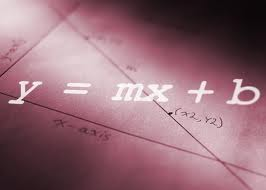
There will be 25 Lessons for Algebra I. There are 4 main topics for Algebra I - 1) Solving Equations, 2) Line y=mx+b, 3) Polynomial & Factoring, 4) Quadratic Equation/Function.
Downloads: Algebra I - CST Released Test*
Algebra I - CST Blueprint*
Before you start Lesson #1, I want you to read Readme page again.
[ Lesson #1 ]
Math Standards 1.0 - Students identify and use the arithmetic properties of subsets of integers and
rational, irrational, and real numbers, including closure properties for the four basic arithmetic operations where applicable (Students use properties of numbers to demonstrate whether assertions are true or false) --> This will be covered in Basic Math.
[ Lesson #2 ]
Math Standards - 2.0 Students understand and use such operations as taking the opposite, finding the
reciprocal, taking a root, and raising to a fractional power. They understand and use the rules of exponents. --> This will be covered in Basic Math.
[ Lesson #3 - Solving Equations ]
Math Standards - 3.0 Students solve equations and inequalities involving absolute values.
[ Lesson #4 - Solving Equations ]
Math Standards - 4.0 Students simplify expressions before solving linear equations and inequalities
in one variable, such as 3(2x-5) + 4(x-2) = 12.
[ Lesson #5 - Solving Equations ]
Math Standards - 5.0 Students solve multistep problems, including word problems, involving linear
equations and linear inequalities in one variable and provide justification for each step.
[ Lesson #6 - Line y=mx+b ]
Math Standards - 6.0 Students graph a linear equation and compute the x- and y-intercepts (e.g., graph
2x + 6y = 4). They are also able to sketch the region defined by linear inequality (e.g., they sketch the region defined by 2x + 6y < 4).
[ Lesson #7 - Line: Point on a Line, Point-Slope Formula ]
Math Standards - 7.0 Students verify that a point lies on a line, given an equation of the line. Students
are able to derive linear equations by using the point-slope formula.
[ Lesson #8 - Line: Parallel & Perpendicular Lines ]
Math Standards - 8.0 Students understand the concepts of parallel lines and perpendicular lines and
how those slopes are related. Students are able to find the equation of a line
perpendicular to a given line that passes through a given point.
[ Lesson #9-25: To be continued ]
Math Standards - 9.0 Students solve a system of two linear equations in two variables algebraically and are able to interpret the answer graphically. Students are able to solve a system of two linear inequalities in two variables and to sketch the solution sets.
10.0 Students add, subtract, multiply, and divide monomials and polynomials. Students solve multistep problems, including word problems, by using these techniques.
11.0 Students apply basic factoring techniques to second- and simple third-degree polynomials. These techniques include finding a common factor for all terms in a polynomial, recognizing the difference of two squares, and recognizing perfect squares of binomials.
12.0 Students simplify fractions with polynomials in the numerator and denominator by factoring both and reducing them to the lowest terms.
13.0 Students add, subtract, multiply, and divide rational expressions and functions. Students solve both computationally and conceptually challenging problems by using these techniques.
14.0 Students solve a quadratic equation by factoring or completing the square.
15.0 Students apply algebraic techniques to solve rate problems, work problems, and percent mixture problems.
16.0 Students understand the concepts of a relation and a function, determine whether a given relation defines a function, and give pertinent information about given relations and functions.
17.0 Students determine the domain of independent variables and the range of dependent variables defined by a graph, a set of ordered pairs, or a symbolic expression.
18.0 Students determine whether a relation defined by a graph, a set of ordered pairs,
or a symbolic expression is a function and justify the conclusion.
19.0 Students know the quadratic formula and are familiar with its proof by completing the square.
20.0 Students use the quadratic formula to find the roots of a second-degree polynomial and to solve quadratic equations.
21.0 Students graph quadratic functions and know that their roots are the x-intercepts.
22.0 Students use the quadratic formula or factoring techniques or both to determine whether the graph of a quadratic function will intersect the x-axis in zero, one, or two points.
23.0 Students apply quadratic equations to physical problems, such as the motion of an object under the force of gravity.
24.0 Students use and know simple aspects of a logical argument:
25.0 Students use properties of the number system to judge the validity of results, to justify each step of a procedure, and to prove or disprove statements:
